President William Ruto has called on Kenya’s diplomats to adopt a more assertive approach in marketing the country as a premium global investment destination, urging them to translate diplomatic engagement into tangible economic gains.
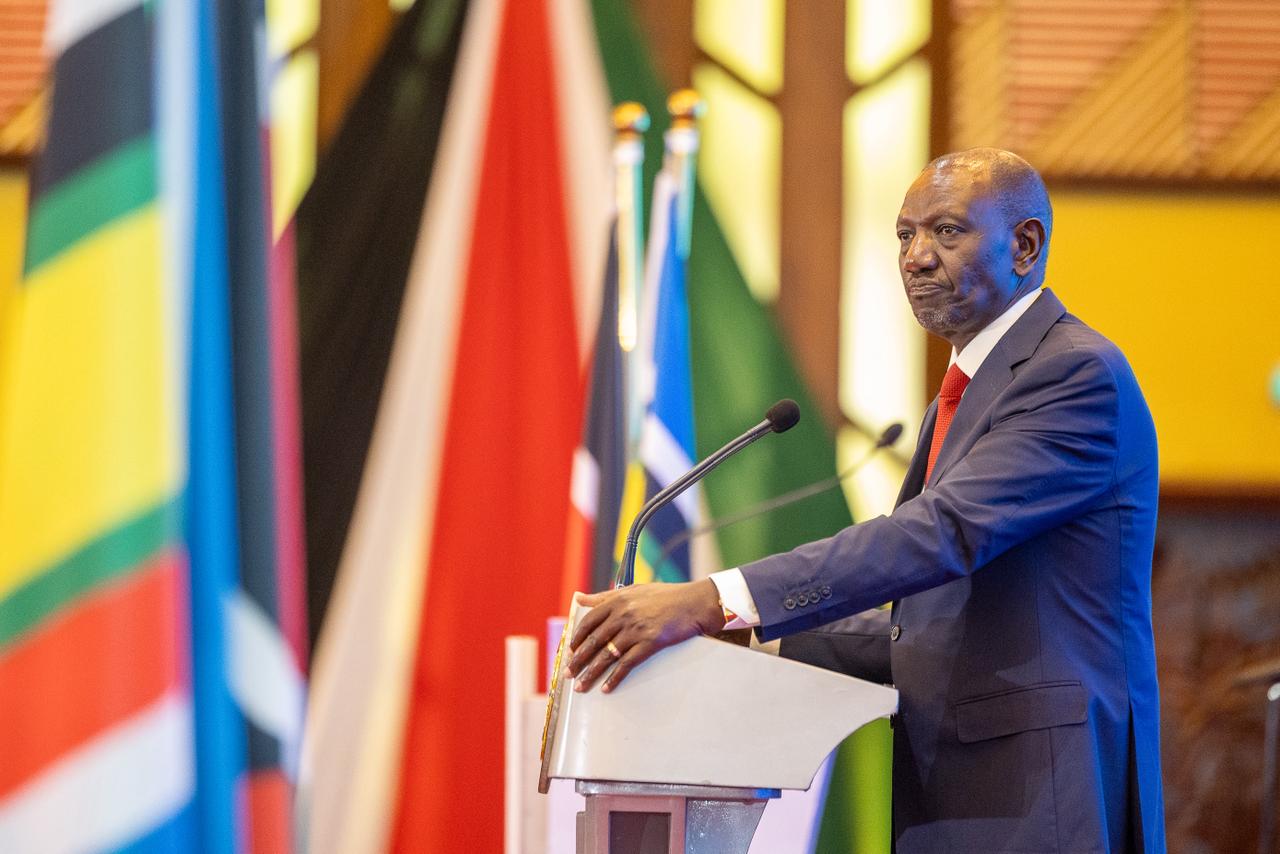
Speaking on Saturday during the 19th Ambassadors and High Commissioners Conference in Nairobi, the President said envoys must take a central role in advancing Kenya’s transformation agenda by shaping global perceptions and securing strategic partnerships.
“You are called upon to articulate, position, and present to the world the full breadth of Kenya’s potential, to tell our story with conviction, and to translate that promise into partnerships that deliver tangible outcomes for our nation,” Ruto said.
He told diplomats that their responsibilities go beyond representation, stressing that they are the face, voice, and standard of Kenya abroad.
“As we work here at home to transform our country, you are the face, the voice, and the standard of Kenya beyond our borders. I call upon you to embody that responsibility with integrity, conviction, and a deep sense of purpose,” he said.
The conference brought together senior government officials including Prime Cabinet Secretary Musalia Mudavadi, Health Cabinet Secretary Aden Duale, Foreign Affairs Principal Secretary Korir Sing'oei, Diaspora Affairs Principal Secretary Roseline Njogu, and more than 70 ambassadors and consuls-general.
Ruto said Kenya has, over the past three years, made significant economic progress and is now implementing a Sh5 trillion transformation plan aimed at repositioning the country as a first-world economy.
He outlined major infrastructure investments under the plan, including the construction of 2,500 kilometres of dual carriageways and 28,000 kilometres of tarmac roads, alongside modernisation of rail systems and upgrades of airports and seaports.
He also highlighted plans to increase power generation capacity from 3,300MW to 10,000MW.
In the water and agriculture sectors, the President said the government intends to construct at least 50 mega dams and over 1,000 smaller dams to support irrigation of 2.5 million acres, particularly in arid and semi-arid regions.
He noted that procurement for the first 15 mega dams had already begun.
“We are re-engineering our nation and our political discourse, ensuring that leaders deliver what they promise; when we make a commitment we must have the plan to execute and make it a reality,” he said.
On the economy, Ruto said reforms including expenditure rationalisation, subsidy cuts, and budget restructuring had stabilised key indicators.
He cited inflation of 4.3 per cent in February 2026, down from 9.6 per cent three years earlier, and said foreign direct investment rose by 15 per cent in 2025, surpassing $2 billion for the first time.
He added that the shilling had stabilised at Sh129 to the dollar for two years, while foreign reserves had risen to $14.6 billion, an increase he said reflects improved economic resilience.
“In a couple of months, the foreign reserves will rise to $16 billion,” he said.
Ruto also pointed to the upgrade of Kenya’s credit rating by Standard & Poor’s from B- to B, describing it as “a clear and credible affirmation of the confidence that global markets have in the direction we have taken.”
In education, he said the government had hired 100,000 teachers and built 23,000 classrooms, while in health he cited the rollout of the Social Health Authority, which he said has registered over 30 million members.
On job creation, the President highlighted the Affordable Housing Programme, which he said has employed more than 640,000 young people, with projections of one million jobs next year.
He also pointed to digital employment initiatives, including ICT hubs, Jitume Centres, and Business Process Outsourcing investments.
“Today, about 300,000 young people are working in this space,” he said, projecting expansion to one million jobs.
He further noted that overseas employment programmes had created 540,000 jobs in three years, while more than 300 multinational companies had established operations in Kenya.
“It is a clear vote of confidence in the direction we have taken as a country, affirming that Kenya is getting the fundamentals right,” he said.
The President urged Kenyans to have confidence in the country’s trajectory, citing Kenya’s invitation by France to represent Africa at the G7 as evidence of growing global influence.
He also reaffirmed Kenya’s regional and continental commitments, including peace support operations in Haiti, the Democratic Republic of Congo, Somalia, South Sudan, and Sudan.
Mudavadi, on his part, said the Ministry of Foreign Affairs was advancing Kenya’s Bottom-Up Economic Transformation Agenda through expanded bilateral trade and investment partnerships with China, the European Union, and the United Arab Emirates.
The President reiterated that Kenya’s diplomatic corps plays a central role in converting domestic reforms into international opportunities that deliver jobs, investment, and long-term economic transformation.